Over 80 years of innovation in yarn texturizing

Patent filing by Billion
In the 1940s, Sofila, under its former name Billion, filed a patent for the invention of a texturing process. Over the years, Billion further developed its expertise in this field by creating new texturing techniques.

Patent filed by Billion in 1953.

Adidas advertisements – 1975 French Cup – Jerseys made from Ultron®, a textured fiber by Billion.
A historic expertise showcased by Adidas in the 1970s.
In the 1970s, major brands like Adidas highlighted Billion’s texturizing processes. The jerseys worn by professional players were made from Ultron®, a synthetic fiber textured by Billion to enhance comfort and performance. These advertisements reflect a historic expertise: a technical process that profoundly transforms a yarn’s behavior, giving it volume, softness, elasticity, and comfort.
Passing on expertise : texturizing
At Sofila, we continue to carry forward these technologies, offering expertise that adapts to the technical, aesthetic, and functional needs of each of our clients.
Texturizing is both a mechanical and chemical process that transforms the original structure of a synthetic yarn to give it new properties. By modifying the arrangement of the filaments, it imparts a new dimension to the yarn in terms of appearance, feel, and performance.
Each yarn is custom-developed according to the client’s technical or aesthetic requirements: count, material, color, volume, elasticity, and texture.
Air texturizing (Taslan)
Air texturizing is a technique that adds volume to a yarn using jets of dry air to intertwine the filaments. Starting from the yarn’s compact structure, the process separates and disorganizes the filaments to create loops, giving the yarn a fuller, softer, and more elastic structure without causing permanent deformation.
Relying on the action of air and water under pressure, this technology stands out for its great versatility. It allows the final result to be adapted according to the materials used and the desired effect, and enables the texturizing of a wide range of yarns, including multiple yarns simultaneously through intimate blending (comélage). This process aims to replicate the look and feel of natural fibers while preserving the technical performance of synthetic fibers.
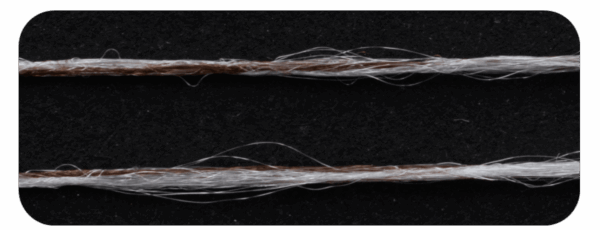
Marl dope dyed PES, 540 dTex
Friction texturizing
Unlike air texturizing, friction texturizing relies on the mechanical deformation of the yarn. The process involves twisting and constraining the filaments, creating bulk and elasticity in the yarn.
The yarn is first heated to a temperature suited to the material and the desired effect. It then passes between tightly pressed rollers, whose rapid rotation generates intense friction. This friction induces a false twist, which permanently alters the yarn’s structure. Depending on the method used, the yarn can either be ready for immediate use or undergo an additional thermal setting step.
Two types of friction texturizing can be distinguished:
- FT (False Twist): The yarn is friction-textured and used as-is, without any additional setting.
- FTF (False Twist with Setting): After deformation, the yarn passes through a thermofixing oven, which locks in the twist and stabilizes the resulting properties.
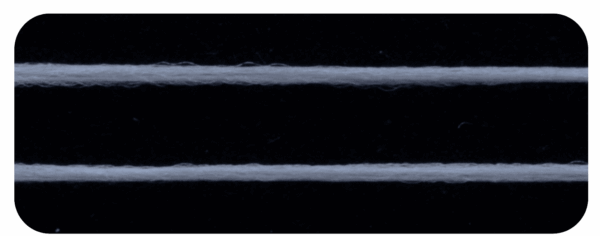
BeCool, 168 dTex
Friction texturizing requires materials that can withstand heat and deformation over time. It is therefore exclusively applied to synthetic fibers, such as polyester or polyamide, which can be thermally shaped and set without compromising their performance.
Spindle texturizing
This process is a mechanical form of texturizing in which the yarn is subjected to high twist using a small metal spindle around which it spins at very high speed before being heated and untwisted.
The spindle, usually of small diameter, deforms the yarn’s structure by creating twists, which in turn generate the desired volume and properties in the textured yarn.
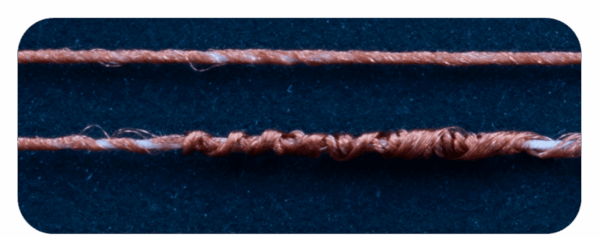
Flame copper PES, 510 dTex
Sofila: A Committed Player in Sportswear Since 1970
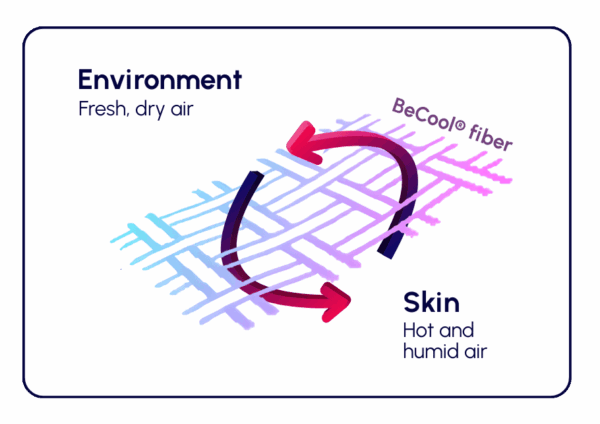
With over 80 years of expertise, Sofila remains a key player in innovative sportswear. We notably develop the thermoregulating fiber BeCool®, designed to meet the comfort and performance demands of athletic use.
Thanks to its quadrilobal structure, BeCool® promotes air circulation and facilitates moisture wicking. To further enhance its performance, Sofila applies specific texturizing processes that improve comfort, add elasticity, and give the yarn greater loft. This combination of technology and know-how enables us to offer textile solutions that are high-performing, durable, and perfectly suited to the demands of modern sportswear.

Discover our Becool® fiber in detail: Everything you need to know about Becool®